Tamara Mihic, Nadia Fairbairn, Seonaid Nolan, Renée Dagenais, Bradley S Quon, and M Eugenia SociasTo cite: Mihic T, Fairbairn N, Nolan S, Dagenais R, Quon BS, Socias ME. Use of buprenorphine/naloxone in an adult with cystic fibrosis. Can J Hosp Pharm. 2025;78(2):e3700. doi: 10.4212/cjhp.3700
Pain is a common comorbidity experienced by people with cystic fibrosis (pwCF), with a pooled prevalence among adults of 77% reported in the literature.1 Potential sources of pain in pwCF include sinusitis, pleurisy, pancreatitis, arthropathy, and rib fractures.1 Pain in pwCF can interfere with necessary treatments to maintain lung health (e.g., airway clearance, physiotherapy, exercise) and has been associated with lower mood, physical functioning, and health-related quality of life.1 General approaches to managing pain in pwCF include nonpharmacological alternatives (e.g., rest, application of heat or cold, massage, acupuncture), non-opioid analgesics (e.g., acetaminophen, nonsteroidal anti-inflammatory agents, antispasmodic treatments, neuropathic pain agents, thoracic epidural analgesia), and opioid analgesics.2 In a survey of 274 adults with CF in the United States, 101 (37.2%) reported receiving a prescription for analgesics, with opioids prescribed for 48 (17.5%).3
Despite the high prevalence of pain in pwCF, there is a paucity of knowledge about pain management and the use of prescription opioids in this population, including the potential benefits and harms of these medications. Here, we describe the successful transition of an adult with CF from hydromorphone to buprenorphine/naloxone for management of chronic pain, including the minimization of adverse effects and symptoms of withdrawal during reduction of the opioid dose.
A 41-year-old man with CF, who was receiving hydromorphone for pain, was admitted to hospital for management of acute nausea and vomiting.* The Opioid Stewardship Program (OSP), delivered by a hospital-based team that aims to optimize prescribing of opioids in the acute care setting, was consulted to assist with opioid management.
Hydromorphone was first prescribed for this patient about 1 year before the hospital admission for pain related to right-sided rib fractures sustained from a fall. Before this injury, he had pre-existing right-sided chest pain related to insertion of a chest tube and pleurodesis for the management of recurrent pneumothorax; this pain was controlled with gabapentin. The hydromorphone was initially helpful for the acute pain related to the rib fractures and facilitated an increase in his physical functioning, but over time it stopped providing as much pain relief. The patient also began to feel dependent on the hydromorphone, and the majority of his time was focused on when he could take his next dose. In this context, the patient was motivated to taper off the hydromorphone.
During a previous hospitalization 8 months before the current admission, he attempted to taper the hydromorphone with support of the hospital’s Complex Pain Team. At that time, he was able to decrease the dose from 8 mg orally every 4 hours to 4.5 mg orally every 4 hours; however, the dose was subsequently increased back to 8 mg every 4 hours following insertion of a jejunostomy tube. Under the care of an outpatient pain clinic, he again attempted to taper his hydromorphone, but was unable to reduce the dose below 7 mg orally every 4 hours. The primary barrier to tapering hydromorphone further, as reported by the patient, was the discomfort associated with withdrawal symptoms of sweats, myalgia, nausea, and malaise. He also noted that the hydromorphone had an erratic analgesic effect, resulting in intermittent and unpredictable withdrawal symptoms between doses. The patient’s dependence on hydromorphone and his desire to avoid withdrawal symptoms began to interfere with his social relationships and limited his time and engagement with his family. He denied taking more or higher doses of hydromorphone than prescribed, taking additional prescribed or nonprescribed opioids, or using any non-oral routes of administration.
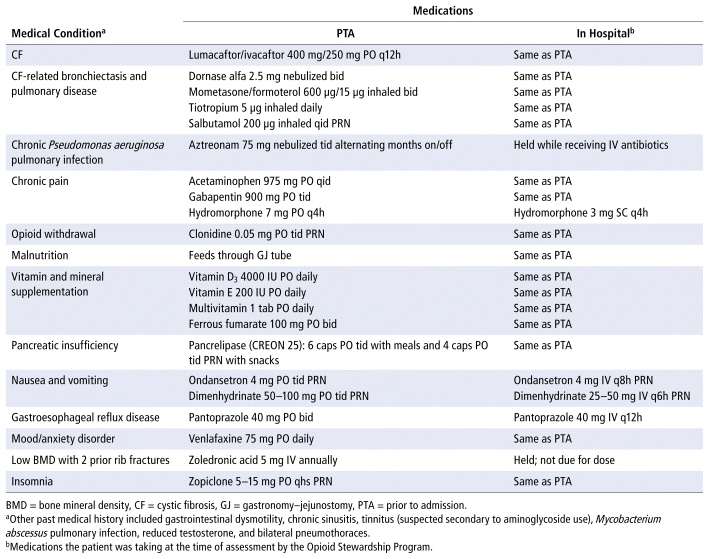
The patient’s medical conditions and medications before admission and in hospital (upon initial assessment by the OSP team) are outlined in Table 1. Upon admission, due to nausea and vomiting, hydromorphone 3 mg subcutaneously (SC) every 4 hours was prescribed. Following their assessment, the OSP team suggested a transition from hydromorphone to sublingual (SL) buprenorphine/naloxone for management of chronic pain, with a subsequent slow taper to achieve the patient’s goal of eventually discontinuing opioid therapy. The rationale for this recommendation included the fact that SL absorption of buprenorphine could bypass potentially erratic absorption in the gut and, hopefully, decrease the occurrence of withdrawal symptoms between doses. Furthermore, once-daily dosing offers more convenience, and the long half-life would allow for a more gradual taper with the possibility of minimizing withdrawal symptoms. It was noted that the patient might need a higher dose of buprenorphine/naloxone due to known interaction with lumacaftor.
TABLE 1 Medical Conditions and Medications for a Patient with Cystic Fibrosis Prior to Admission and In Hospital
The patient agreed to the initiation of buprenorphine/naloxone according to the following microdosing regimen (dose indicating buprenorphine component): 1 mg SL once (day 1), 1 mg SL twice daily (day 2), 2 mg SL twice daily (day 3), 2 mg SL 3 times daily (day 4), 4 mg SL twice daily (day 5), 12 mg SL once daily (day 6), 16 mg SL daily (day 7 onward). Hydromorphone was continued at 3 mg SC q4h and discontinued on day 7 of the buprenorphine/naloxone titration.
The patient tolerated the transition to buprenorphine/naloxone well and did not require any of the as-needed buprenorphine/naloxone doses that were available to him. He described feeling anxious during the process, particularly before discontinuation of hydromorphone, but did not experience any physical symptoms of withdrawal or change in his overall pain. He was discharged on buprenorphine/naloxone 16 mg/4 mg SL once daily. He continued to taper the buprenorphine/naloxone in the community, with initial success; however, over the subsequent 18-month period, his dose fluctuated due to new acute pain events, including dental pain, pleural effusion, and empyema. His dose peaked at 18 mg/4.5 mg per day before treatment of the empyema. After this, his dose was tapered back down to 16 mg/4 mg per day before transition to monthly SC injection of extended-release buprenorphine; the plan was to use the long half-life of the injection to help taper off buprenorphine. He received 2 monthly doses of 300 mg, followed by 2 monthly doses of 100 mg. He then began to taper by extending the dosing interval to 5 weeks before the fifth injection, 6 weeks before the sixth injection, and then discontinuing altogether. At the time this report was prepared, it had been 2 months since his last injection, and he denied any worsening pain or withdrawal symptoms.
Pain is commonly reported by pwCF and is associated with negative effects on health-related outcomes.1 Therefore, a more comprehensive understanding of the various pain management options suitable for this population is vital to optimizing overall health and quality of life.
In addition to the established indication for treatment of opioid use disorder, buprenorphine is an effective analgesic with growing evidence for equivalent or superior efficacy relative to conventional opioids; furthermore, it is indicated, in other formulations, by the US Food and Drug Administration for chronic pain management.4 As a partial opioid agonist, buprenorphine carries a lower risk of opioid-related adverse effects; of particular interest for pwCF is the lower risk of respiratory depression, immunosuppression, constipation, and fractures.4,5 The partial agonist effect and inclusion of naloxone are also important in the context of potential opioid misuse; in a study involving 148 adults with CF, 10% of individuals were found to have documentation of problematic opiate use more than once in their electronic chart.6 Furthermore, the SL formulation offers an option for those who, like this patient, experience erratic absorption from their gut. The more gradual dissociation from the mu-opioid receptors and the prolonged half-life of buprenorphine relative to other opioids reduce the risk of withdrawal symptoms between doses and in those wishing to taper.4 Of note, the duration of analgesic effect may be shorter than the terminal half-life,7 and patients often benefit from divided doses for pain management. In this case, the patient used both once-daily and twice-daily dosing at various times while taking buprenorphine/naloxone.
Pain and long-term opioid use are important concerns in pwCF. This case highlights that opportunities for optimizing chronic pain management exist for pwCF and that buprenorphine/naloxone presents a unique treatment option for consideration in patients requiring opiates for pain management. Given that these findings are limited to a single descriptive case, further research is required to identify optimal pain management strategies in pwCF and to evaluate clinical outcomes with buprenorphine/naloxone in this population.
1 Lee AL, Rawlings S, Bennett KA, Armstrong D. Pain and its clinical associations in individuals with cystic fibrosis: a systematic review. Chronic Respir Dis. 2016;13(2):102–17.
Crossref
2 Havermans T, Colpaert K, De Boeck K, Dupont L, Abbott J. Pain in CF: review of the literature. J Cystic Fibrosis. 2013;12(5):423–30.
Crossref
3 Allgood S, Zemlak JL, Dellon E, Kapnadak SG, Goggin J, Lechtzin N. Satisfaction and effectiveness of opioid pain management among adults with cystic fibrosis: a mixed methods study. J Cystic Fibrosis. 2022;21(1):e15–22.
Crossref
4 Kumar R, Viswanath O, Saadabadi A. Buprenorphine. In: StatPearls. StatPearls Publishing; updated 2023 Feb 27 [cited 2024 Aug 6]. Available from: https://www.ncbi.nlm.nih.gov/books/NBK459126/
5 Hale M, Garofoli M, Raffa RB. Benefit-risk analysis of buprenorphine for pain management. J Pain Res. 2021;14:1359–69.
Crossref PubMed PMC
6 Richards CJ, Friedman D, Pinsky H, Gootkind E, Lee H, Yonker L, et al. Alcohol and opiate misuse in adults with cystic fibrosis. Pediatr Pulmonol. 2023;58(9):2535–42.
Crossref PubMed
7 Vadivelu N, Anwar M. Buprenorphine in postoperative pain management. Anesthesiol Clin. 2010;28(4):601–9.
Crossref PubMed
*The patient provided written consent for publication; nonetheless, potentially identifying demographic characteristics have been minimized.
Address correspondence to: Dr Tamara Mihic, British Columbia Centre on Substance Use, 400 – 1045 Howe Street, Vancouver BC V6Z 2A9, email: tmihic@providencehealth.bc.ca
Competing interests: For activities not directly related to the case reported here, Nadia Fairbairn has received a research grant from the National Institutes of Health (US) and has served on an institute advisory board for the Canadian Institutes of Health Research and the Executive Committee of the BC Substance Use Conference; Seonaid Nolan has received research funding of various types from the Providence Health Care Research Institution, Indivior, the Michael Smith Foundation for Health Research, and the University of British Columbia; Renée Dagenais has received support from the Cystic Fibrosis Foundation (CFF) to attend and speak at a CFF conference; and Eugenia Socias has received research funding from Indivior. Other than the research funding outlined below, no other competing interests were declared.
Funding: Tamara Mihic’s work is supported by the International Collaborative Addiction Medicine Research Fellowship through the British Columbia Centre on Substance Use. Funding for this fellowship program is supported by the US National Institutes of Health/National Institute on Drug Abuse (NIH grant R25-DA037756).
Acknowledgements: The authors would like to acknowledge the contribution of our patient partner and their willingness to share details of their case to inform pain treatment for people with cystic fibrosis.
Submitted: September 6, 2024
Accepted: October 31, 2024
Published: June 11, 2025
© 2025 Canadian Society of Healthcare-Systems Pharmacy | Société canadienne de pharmacie dans les réseaux de la santé
Canadian Journal of Hospital Pharmacy, VOLUME 78, NUMBER 2, 2025