CSHP Vision for Pharmacy Task ForceTo cite: CSHP Vision for Pharmacy Task Force. The CSHP vision for pharmacy. Can J Hosp Pharm. 2025;78(1):e3746. doi: 10.4212/cjhp.3746
“Vision without action is merely a dream. Action without vision just passes the time.” This quotation, attributed to futurist Joel Arthur Barker, touches on the very purpose of this article and the vision for pharmacy that it describes.
Pharmacy professionals do not routinely struggle with action. Not that there isn’t room for improvement, but the profession’s progress over the past many decades demonstrates will and resourcefulness, despite a scarcity of external supporters or the lack of a clear pathway to a defined destination. Getting stuff done is not the issue.
However, development of a pharmacy vision—one for the entire profession—is challenging, perhaps now more than ever. Our predecessors in the field deserve credit for the state of the profession that they have passed down: having the foresight to integrate pharmacists into the patient’s care team, to empower pharmacy technicians to be leaders and experts in managing the medication supply chain, and to leverage technology for all its potential. Coupled with the knowledge, skills, and mind set to get things done, great feats have been achieved. In addition to engendering immense gratitude, these achievements may also cause us to experience less comfortable feelings of uncertainty, as we wonder “What’s next?” Now is a time when pharmacy professionals need to look to tomorrow, and that is why the Canadian Society of Hospital Pharmacists (now the Canadian Society of Healthcare-Systems Pharmacy or CSHP) set out to develop the next vision: to provide something to strive for, a vision that will bring meaning to every pharmacy action for today, the foreseeable future, and beyond. After all, “If you want to go fast, go alone; if you want to go far, go together” (African proverb).
Emerging from the most recent pandemic, CSHP recognized that the profession was facing significant threats. There was action on many fronts, but action without clear direction may or may not be meaningful. Or, to say it another way, there was a risk of making changes simply for the sake of change.
It had been almost a decade since the Blueprint for Pharmacy1 was sunsetted, and even then, that particular resource had referred only loosely to the types of care that CSHP members may aim to provide. The International Pharmaceutical Federation’s Basel Statements on the Future of Hospital Pharmacy,2 the American Society of Health-Systems Pharmacists (ASHP) long-range vision for the pharmacy workforce in hospitals and health systems,3 and the ASHP Pharmacy Advancement Initiative4 have many strengths and, if they’d been written in our context—Canadian public sector pharmacy—might have provided enough direction for us.
Talented and hard-working CSHP members had immense ability to do good things, but what were all these efforts contributing to? At worst, divergence and incompatibility were apparent; at best, convergence and unity were not. Determining what products and services a professional association should offer was nearly impossible when various members felt the profession was moving in disparate directions. Not to mention the threat of an externally imposed vision or direction, which could not be ignored. Therefore, a CSHP task force was struck with the purpose of developing and recommending a vision for the hospital pharmacy profession in Canada: a North Star (see Box 1), a guiding light, a compass, a fixed point toward which we could strive.
Since time immemorial, the North Star, also known as Polaris, has served as a secular symbol for bringing people together. A fixed navigation point, Polaris is the closest star (3 stars, actually) to Earth’s North Pole, and as such its position in space is seemingly unmoving, despite the turning of the globe. Both practically and figuratively, the North Star has been used as a compass by countless generations of Indigenous peoples, by sailors, in the corporate world, and so on. As such, it serves as a powerful analogy, though its inclusivity is limited by irrelevance in the southern hemisphere. It is used here synonymously with “vision” and represents a destination—though our paths and the tools we use to get there may vary—toward which we are all headed.
Task force activities included performing environmental scans, developing internal document and resource inventories, and searching for position and vision statements of other pharmacy organizations. The task force reviewed all of these materials, harvesting proto-candidate vision statements. The search resulted in an abundance of statements, yet gaps remained and overlap abounded. The task force determined that a first set of candidate recommendations could be extracted from the ASHP Pharmacy Advancement Initiative,4 a near-comprehensive resource derived from a North American setting (where pharmacy practice is not so very different from that in Canada). Still, adaptation would be needed, and concision and representative consensus were desired. Therefore, in summer 2023, the task force recruited a Delphi panel. In addition to pharmacy technician and pharmacist members of CSHP, the panel included representation from patient advocacy groups, the Indigenous Pharmacy Professionals of Canada, the Association des pharmaciens des établissements de santé du Québec, the Canadian Association of Pharmacy Students and Interns, the Association of Faculties of Pharmacy in Canada, and 2SLGBTQA+ advocacy groups, as well as some members of the task force itself.
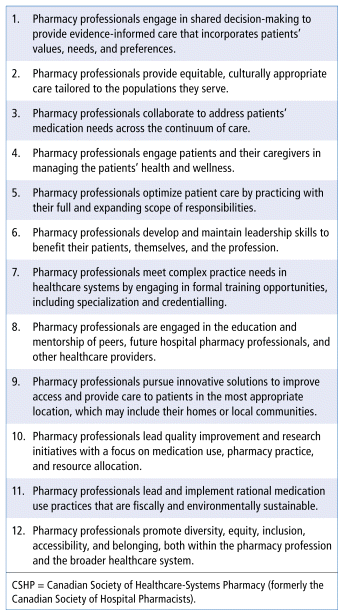
Three Delphi rounds were successfully completed: round 1, in July 2023, had 31 participants; round 2, in August 2023, had 27 participants; and round 3, in September 2023, had 26 participants. Over the course of the 3 rounds, the 26 original statements were first whittled down to 16, and those 16 were further reduced to 12 (Box 2). While progressing through the Delphi rounds, the panel was presented with statements that were increasingly intended to be “MECE”5—mutually exclusive and collectively exhaustive—a feature that we did not routinely see in other organizations’ resources. The task force feared that absence of MECE structure could result in 2 main concerns. The first of these was potential overlaps; for example, pharmacists’ and technicians’ use of technology for patient care raised the question of the domain where technology statements would be included: A “pharmacist” section? A “pharmacy technician” section? A “technology” section? Only one? A combination? The second concern was potential gaps; for example, in articulating a vision or position intended for pharmacy, we had to also ensure there was no perceived intention to forgo collaboration with patients and other care providers. Each statement was intended to stand on its own while leaving nothing unsaid.
BOX 2. CSHP Vision Statements for Pharmacy
In terms of statement structure, the 12 vision statements were designed to embody 2 other key “hinging” characteristics: first, to be “evergreen” and thus relevant today, tomorrow, and beyond; and second, to strike a balance by providing enough detail and direction without encumbering the freedom and flexibility for innovation, allowing the vision to adapt as it goes the distance.
While consensus was achieved, there were trade-offs in settling on the final wording. Some feedback suggested that certain statements did not feel aspirational and instead read like expectations of the profession. Our response to these questions was, and remains, that in writing the statements as MECE and evergreen—to stand the test of time—we needed to paint a picture of what pharmacy practice should look like in near-entirety in the future. Further, some statements may have survived through the Delphi rounds and are included in the final set of statements simply because they protect against threats and/or competing interests or they indicate a preferred direction when there is potentially another or multiple other paths to take. Other criticisms may include a sense that some statements don’t feel hospital-focused. In this regard, we would remind readers that CSHP has for a long time represented not only hospitals but also other collaborative healthcare settings, including ambulatory care, primary care, and other settings in the healthcare system. It is the public sector, not-for-profit nature of our work, not bricks-and-mortar institutions, that binds us to these vision statements.
The work is not done. Details will need to be layered onto the vision, to bring it to life. We must strategize and execute in order to get to the place we want to go. What goals and objectives can we set that will put us on the right course? This is where you, the reader, come in.
In his landmark book, Leading Change,6 John P Kotter shared lessons derived from the mistakes organizations have made trying to implement change.7 Although the profession of pharmacy is not a singular company per se, it is an enterprise.8 And just like every other enterprise, pharmacy is ultimately an enterprise within other, larger enterprises—the greater healthcare industry, the public sector, and more—and has smaller enterprises cascading within it: pharmacies and pharmacy departments, teams, individual practitioners, and so on.
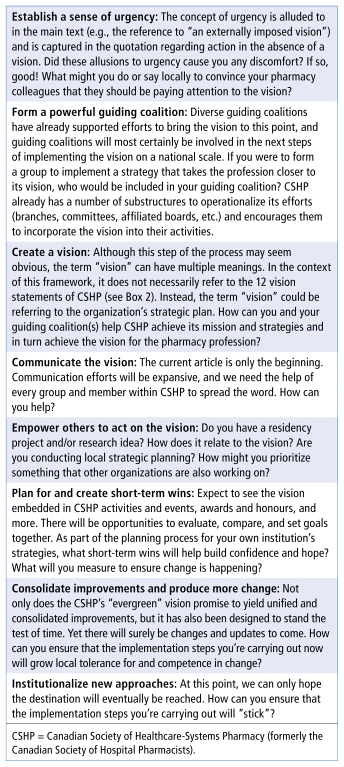
As such, we propose a framework for implementation based on Kotter’s 8-step process (Box 3), which is applicable to every layer of the pharmacy profession: CSHP, pharmacy leaders and administrators, and pharmacy practitioners. This framework briefly touches on the efforts that CSHP has already started or will soon undertake to carry out the 8 steps recommended in Kotter’s model, at the same time providing pharmacy professionals with a tool for action. When applied, this tool will allow pharmacy professionals to enact the vision within their own contexts. As much as CSHP wants the vision to serve as and provide direction, the idea is also for pharmacy professionals to innovate and tell CSHP what the vision can mean.
BOX 3. A Framework for Pharmacy Professionals, Based on Kotter’s 8-Step Process6,7
The truth is, there’s more to the Barker quotation that opens this article: “Vision without action is merely a dream. Action without vision just passes the time. Vision with action can change the world.” When you consider the ubiquity of medications, their significant potential to help or to harm patients, and the need for highly dedicated healthcare providers to care for fellow human beings in their most vulnerable states, it is not grandiose to think that pharmacy professionals can change the world. Our coordinated and directed efforts together and as cooperating individuals can make it happen.
1 Blueprint for pharmacy: our way forward: optimizing drug therapy outcomes for Canadians through patient-centred care. Canadian Pharmacists Association; 2013 [cited 2024 Oct 18]. Available, through Canada Commons, from: https://coilink.org/20.500.12592/ffrd9t
2 Basel Statements: the future of hospital pharmacy practice. International Pharmaceutical Federation (FIP); [cited 2024 Oct 17]. Available from: https://www.fip.org/basel-statements
3 ASHP long-range vision for the pharmacy workforce in hospitals and health systems. Am J Health Syst Pharm. 2020;77(5):386–400. doi: 10.1093/ajhp/zxz312
Crossref
4 PAI [Pharmacy Advancement Initiative] 2030 [website]. American Society of Health-System Pharmacists; [cited 2024 Oct 17]. Available from: https://www.ashp.org/pharmacy-practice/pai?loginreturnUrl=SSOCheckOnly
5 Barbara Minto: “MECE: I invented it, so I get to say how to pronounce it”. In: Alumni news. McKinsey & Company; [cited 2024 Oct 18]. Available from: https://www.mckinsey.com/alumni/news-and-events/global-news/alumni-news/barbara-minto-mece-i-invented-it-so-i-get-to-say-how-to-pronounce-it
6 Kotter JP. Leading change. Harvard Business Review Press; 2012.
7 Kotter JP. Leading change: why transformation efforts fail. Harv Bus Rev. 1995;73(2):59–67.
8 Knoer S. Stewardship of the pharmacy enterprise. Am J Health Syst Pharm. 2014;71(14):1204–9.
Crossref PubMed
Address correspondence to: Zack Dumont, Pharmacy Services, Saskatchewan Health Authority—Regina Area, 1440 14th Avenue, Regina SK S4P 0W5, email: zack.dumont@saskhealthauthority.ca
Competing interests: For activities unrelated to the work reported here, Richard Slavik has received consulting fees from Gilead Sciences Canada. No other competing interests were declared.
Funding: None received.
Acknowledgements: The following individuals participated in the Delphi panel to refine and validate the vision statements, providing indispensable input to this initiative: Kimberley Abbass, Arden Barry, Andrea Beaman, Laura Bennett, Richard Cashin, Janet Cooper, Karen Dahri, Melanie Danilak, Bal Dhillon, Doug Doucette, Sadaf Faisal, Yayoi Goto, Steven Kary, Minh-Hien Le, Kang Wei (David) Liu, Sarah Lutes, Winnie Ma, Nathalie Marceau, Jarrid McKitrick, Chantal Michaud, Tania Mysak, Thomas Parker, Megan Riordon, Bill Semchuk, Steve Shalansky, Garland Sharatt, Nancy Sheehan, Sean Spina, Jaris Swardovich, Ashley Walus, Sarah Way, Kyle Wilby, and Madison Wong.
Submitted: November 9, 2024
Accepted: November 23, 2024
Published: March 12, 2025
© 2025 Canadian Society of Healthcare-Systems Pharmacy | Société canadienne de pharmacie dans les réseaux de la santé
Canadian Journal of Hospital Pharmacy, VOLUME 78, NUMBER 1, 2025