Original Research
Student Integration into Hospital Clinical Pharmacy Services in an Advanced Pharmacy Practice Experience: A Process Evaluation
Natalie Kennie-Kaulbach, Naomi Milner, Harriet Davies, Martina Greco, Jennifer MacDougall, and Kyle John Wilby
To cite: Kennie-Kaulbach N, Milner N, Davies H, Greco M, MacDougall J, Wilby KJ. Student integration into hospital clinical pharmacy services in an Advanced Pharmacy Practice Experience: a process evaluation. Can J Hosp Pharm. 2025;78(3):e3763. doi: 10.4212/cjhp.3763
ABSTRACT
Background
Student integration into clinical pharmacy services during Advanced Pharmacy Practice Experiences (APPEs) is helpful for both student learning and patient care. Identifying how to integrate students into clinical pharmacy services during APPEs is likely to be site-specific, depending on the pharmacy department’s service emphasis and capacity in the particular health care setting.
Objective
To identify elements of rotation implementation that facilitated pharmacy students’ learning and integration into hospital clinical pharmacy services during a Collaborative Health Care (CHC) setting APPE.
Methods
The study involved students and preceptors who participated in rotations over a 1-year period (May 2023 to April 2024) at a single Canadian faculty of pharmacy. A process evaluation approach was used to collect students’ and preceptors’ perceptions about the integration of students into clinical services and the types of clinical services that students were able to complete. Data for analysis were collected from transcripts of virtual interviews with students and preceptors, rotation evaluations, and patient-procedure logs submitted by students.
Results
Totals of 71 students and 166 primary preceptors and co-preceptors at 21 rotation sites were eligible to participate. Of these, 11 students and 17 preceptors from 9 rotation sites were interviewed. All 71 students (100%) and 56 (34%) of the preceptors completed online rotation evaluations. Analysis and triangulation of data sources yielded 6 main theme categories related to integration of students into clinical services during the CHC APPE rotation.
Conclusions
This evaluation of the integration of pharmacy students into clinical services during their CHC APPEs in the hospital setting identified elements that positively supported students’ learning and their contribution to the practice setting. Both preceptors and students valued student integration. Lessons learned in this project may be helpful for other pharmacy experiential education programs.
Keywords: experiential education, clinical pharmacy key performance indicators, pharmacy students, evaluation
RÉSUMÉ
Contexte
L’intégration des étudiants dans les services de pharmacie clinique lors d’une expérience pratique avancée de la pharmacie (EPAP) est bénéfique tant pour leur apprentissage que pour les soins aux patients. La détermination des façons d’intégrer les étudiants dans des services de pharmacie clinique lors des EPAP est probablement spécifique au site, en fonction de l’accent mis sur certains services par le département de pharmacie et de la capacité de l’environnement particulier de soins de santé.
Objectif
Recenser les éléments de la mise en œuvre des rotations qui ont facilité l’apprentissage des étudiants en pharmacie et leur intégration dans les services de pharmacie clinique hospitalière lors d’une EPAP en environnement de soins de santé collaboratifs (SSC).
Méthodologie
L’étude a impliqué des étudiants et des précepteurs ayant participé à des rotations durant une période d’un an (de mai 2023 à avril 2024) dans une seule faculté de pharmacie canadienne. Une approche d’évaluation de processus a été utilisée pour recueillir les perceptions des étudiants et des précepteurs concernant l’intégration des étudiants dans les services cliniques et les types de services cliniques que les étudiants ont été en mesure de réaliser. Les données ont été recueillies pour analyse à partir des transcriptions d’entretiens virtuels avec les étudiants et les précepteurs, des évaluations des rotations et des dossiers relatifs à des procédures effectuées sur les patients soumis par les étudiants.
Résultats
Au total, 71 étudiants et 166 précepteurs principaux et co-précepteurs, provenant de 21 sites de rotation, étaient admissibles à l’étude. Parmi eux, 11 étudiants et 17 précepteurs de 9 sites de rotation ont été interviewés. Les 71 étudiants (100 %) et 56 des précepteurs (34 %) ont complété les évaluations de rotation en ligne. L’analyse et la triangulation des sources de données ont permis de dégager 6 grandes catégories thématiques liées à l’intégration des étudiants dans les services cliniques lors de la rotation d’EPAP en environnement de SSC.
Conclusions
Cette évaluation de l’intégration des étudiants en pharmacie dans les services cliniques lors de leurs EPAP en environnement de SSC en milieu hospitalier a permis de recenser des éléments qui soutiennent positivement l’apprentissage des étudiants et leur contribution au cadre de pratique. Tant les précepteurs que les étudiants ont valorisé l’intégration des étudiants. Les leçons tirées de ce projet pourraient être utiles pour d’autres programmes d’éducation expérientielle en pharmacie.
Mots-clés: éducation expérientielle, indicateurs clés de performance en pharmacie clinique, étudiants en pharmacie, évaluation
INTRODUCTION
In support of pharmacists’ expanded scope of practice, the expansion of experiential education in the new entry-level Doctor of Pharmacy degree in Canada has brought both challenges and opportunities. Of particular interest is the resulting need to expand practice-based learning time and capacity in the inpatient hospital setting. Challenges have included increasing demand for student training sites, limitations on site capacity, and requirements for orientation of learners in practice settings.1 The extended duration of students’ practice-based learning and the need to provide autonomous learning activities in preparation for independent practice present opportunities to engage students in core pharmacy activities that are mutually beneficial to learning and patient care. Involving students to act as “care extenders” of pharmacists increases patients’ access to pharmacist care with the additional benefit of enhancing the student learning experience.2–4 The integration of students into patient care activities is an important part of experiential learning and may enhance the satisfaction of preceptors and facility administrators.4
A scoping review identified positive contributions of undergraduate students in the provision of a wide range of direct patient care services during experiential rotations in the inpatient hospital setting.5 The scoping review showed that pharmacy students were involved in activities related to clinical pharmacy key performance indicators (cpKPIs), with resulting increases in service counts and positive process and/or clinical outcomes. The integration of pharmacy students into existing pharmacy services not only has the potential to expose patients to key pharmacist activities but may also have a mutually beneficial role in building the students’ knowledge and skills while improving patient outcomes. Integration and participation within the practice setting have been theorized to support the formation of students’ professional identity6 and are essential to meaningful learning in the workplace.7
Experiential education programs in Canada have used key strategies to expand experiential education for pharmacy learners in the hospital setting. Cameron and others8 at the University Health Network in Toronto, Ontario, proposed several strategies to expand Advanced Pharmacy Practice Experiences (APPEs), including selecting specific patient care activities for APPE learners, providing formal learner training and onboarding, and using nontraditional preceptor models. In British Columbia, the Advancing Experiential Learning in Institutional Pharmacy Practice (also known as AGILE) project advocated for establishing mutually beneficial patient care activities to be performed by students as a way to build capacity in experiential education.2 Identifying how to integrate students into clinical pharmacy services or cpKPI activities during APPEs is likely to be site-specific, depending on the pharmacy department’s service emphasis and capacity within the health care setting.
The College of Pharmacy at Dalhousie University in Halifax, Nova Scotia, recently implemented its Entry-Level Doctor of Pharmacy curriculum. One of the core direct patient care APPEs is a 12-week rotation in a Collaborative Health Care (CHC) setting, which includes the hospital setting. One goal of the CHC rotation is to integrate students into the pharmacy workflow and team so they can actively practice and demonstrate practice readiness, goals that align with the current (2023) accreditation standards of the Canadian Council for Accreditation of Pharmacy Programs.9 Students complete a variety of activities, as outlined in the rotation manual, which aim to support them in achieving their rotation outcomes. A key focus of the CHC APPE rotation activities is to provide students with opportunities to provide care in both uncomplicated and more complex cases by completing patient care workups for an assigned case load. In conjunction with or in addition to these patient care activities, the rotation guide also encourages integration of students into clinical pharmacy services offered at partner sites. Hospital pharmacy services across the Maritime provinces (New Brunswick, Nova Scotia, and Prince Edward Island) are funded by the respective provincial governments, and pharmacy services on site vary with staffing, budget, and service needs of the population.
To fulfill these patient care rotation activities, preceptors and site administrators were encouraged to consider opportunities where learners could be positioned to support and contribute to the delivery of core clinical pharmacy services or cpKPI activities to extend direct patient care delivery by pharmacists at the site. Since the approach to integrating clinical services was flexible at each practice site, plans for the practice experience program included evaluating student and preceptor experiences during the inaugural APPE rotation to inform future changes and supports to facilitate student integration and learning. The aim of this project was to identify elements of rotation implementation that facilitate integration of students into hospital clinical pharmacy services during a CHC APPE across partner sites in the Maritime provinces.
METHODS
The study used a process evaluation approach based on the Context, Input, Process, Product (CIPP) model originally created by Stufflebeam and Coryn.10 This evaluation model can be used in educational settings to systematically collect information about a program or course so as to identify strengths and limitations in content or delivery and thus to improve program effectiveness and inform future changes.11 A process evaluation poses specific questions to assess how the program was implemented.10,11 The process evaluation questions for this study are shown in Box 1.
BOX 1. Process Evaluation Questions for the Study
- How were the rotation activities implemented compared to the description and guidance provided in rotation manual?
- What clinical services, including clinical pharmacy key performance indicators, were pharmacy students integrated into during their 12-week rotation?
- How were pharmacy students integrated into clinical services?
- What factors helped to support implementation of pharmacy student integration into clinical services, and what challenges were encountered?
- What were pharmacy students’ and rotation sites’ perceptions about the overall value of rotation activities?
Data Collection
To understand how students were integrated into clinical pharmacy services during the rotation, data were collected from virtual interviews, rotation evaluations, and patient-procedure logs.
Preceptor and Student Interviews
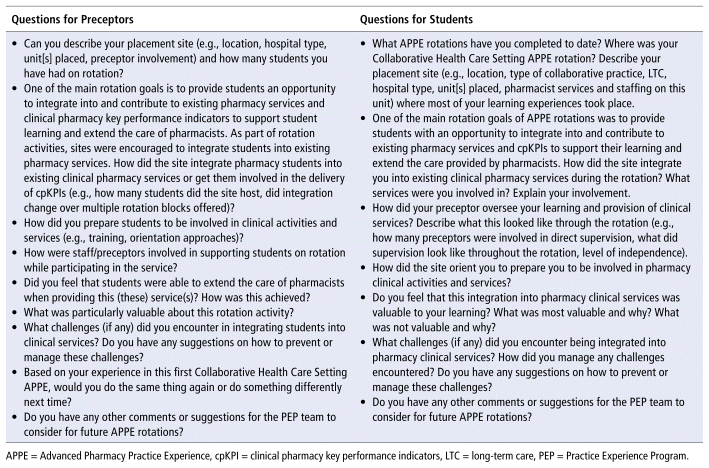
Preceptors who hosted students and students who completed an APPE rotation in the 1-year period May 2023 to April 2024 were selected by purposive sampling to capture a range of the 21 partner rotation sites representing different facility sizes, urban and rural locations, and provinces within the Maritimes. Each preceptor and student received an email message explaining the study and inviting the recipient to complete a 30-minute semistructured virtual interview (either individually or in a group). Those who expressed interest were scheduled for an interview and were asked to provide consent to have the interview recorded. If more than one preceptor from a rotation site was interested in completing an interview, a multi-participant interview was conducted. Interviews were completed within 2 to 3 weeks of completion of the APPE. Interview questions focused on how the rotation was implemented, the clinical services into which students were integrated, and facilitators and barriers to implementing rotation activities (see Appendix 1 for the interview guide). Interviews were conducted and automatically transcribed using Microsoft Teams software (version 1.6.00.18681, Microsoft Corporation). For each group, the same team member conducted all interviews; N.K.K., the course coordinator for APPE rotations, conducted the preceptor interviews, and M.G., the program evaluation specialist, conducted the student interviews. A pharmacy student research assistant (N.M.) reviewed (for accuracy) and edited the transcripts.
Rotation Evaluations
At the end of the 12-week APPE rotation, students and primary preceptors completed online evaluations in One45 rotation management software (Acuity Insights). Evaluation responses for specific questions relevant to the study for students (i.e., what they enjoyed most about the rotation, suggestions for improvement) and preceptors (i.e., how students were integrated into clinical services) were extracted from the evaluations for analysis.
Patient-Procedure Logs
Patient-procedure logs are electronic forms that students completed in the One45 rotation management system to capture rotation activities related to Canadian consensus cpKPIs12 and other clinical pharmacy activities (e.g., postdischarge follow-up, antimicrobial stewardship, injections, and risk assessment). Each student completed patient-procedure logs for pharmacy clinical services delivered during the last 4 weeks of their APPE rotation.
Data Analysis
Interviews were analyzed for themes related to process evaluation questions using thematic analysis.13 Transcripts were inductively coded by 2 team members (N.M., a pharmacy student research assistant, and N.K.K., the APPE course coordinator) to ensure diverse perspectives in the coding process. The first analyst (N.M.) initially coded the transcripts, and the second analyst (N.K.K.) reviewed the transcripts and codes to confirm agreement and identify additional codes. The coders further refined the initial codes using an iterative process of review and discussion to combine similar codes into broader categories; they then interpreted preliminary themes from categorized data. The preliminary themes were then reviewed and discussed by the research team and refined into final themes.
Responses to student and preceptor rotation evaluations were analyzed by one team member (N.M.) for excerpts related to the program evaluation questions to triangulate the data source with participant interviews. Patient-procedure logs were summarized using descriptive statistics (e.g., number and type of services logged).
Ethics Review
Given that the scope of this project was program evaluation, it received an exemption from research ethics review from the Office of Research Services at Dalhousie University.
RESULTS
Totals of 71 students and 166 primary preceptors and co-preceptors at 21 rotation sites were eligible to participate. Eleven (15%) of the 71 students, who had completed their rotations at 9 (43%) of the rotation sites, were interviewed. Across the Maritime provinces, 6 students completed the clinical placement in Nova Scotia, 4 in New Brunswick, and 1 in Prince Edward Island. Seventeen (10%) of the 166 preceptors, also representing 9 (43%) of the rotation sites, participated in a total of 10 interviews (either individual or group). Eleven of the preceptors were from a clinical placement site in Nova Scotia, 3 were from New Brunswick, and 3 were from Prince Edward Island.
All 71 students (100%) and 56 preceptors (34% of the primary preceptors and co-preceptors involved in APPE rotations) completed the online rotation evaluation. In addition, the 71 students completed a total of 5721 patient-procedure logs. Analysis and triangulation of data sources identified the following 6 main theme categories related to student integration into clinical services during the CHC APPE rotation: targeted student involvement in clinical activities, focused task approach to facilitate student integration, establishment of trust to facilitate integration, site-specific approaches to facilitate integration, facilitators and barriers to student integration, and the value of student integration.
Targeted Student Involvement in Clinical Activities
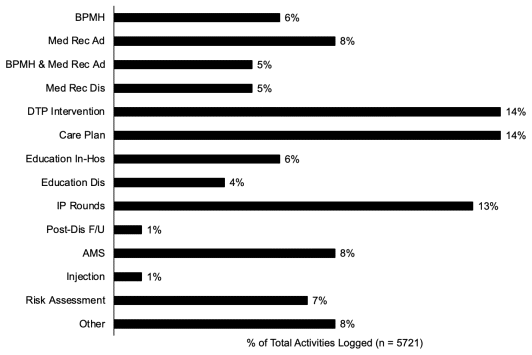
The students and preceptors who participated in interviews described student involvement in tasks categorized as those completed more independently with supervision and those completed with more guidance and direct supervision. Tasks requiring more guidance and direct supervision included patient care workups, prescribing, antimicrobial stewardship, and resolution of drug therapy problems (DTPs). In contrast, some activities were completed more independently by the student after gaining the preceptor’s trust and demonstrating their competence. These tasks included medication reconciliation, patient education, research on drug therapy questions, and identification of DTPs. The 5721 patient-procedure logs documented students’ participation in a variety of clinical pharmacy activities, the most frequent being different medication reconciliation activities (totalling 24%), creation of care plans (14%), interventions on identified DTPs (14%), and participation in interprofessional care rounds (13%) (Figure 1).
|
| |
|
FIGURE 1 Breakdown of clinical activities logged by 71 students and submitted during Advanced Pharmacy Practice Experience rotations in Collaborative Health Care settings. Ad = admission, AMS = antimicrobial stewardship, BPMH = best possible medication history, Dis = discharge, DTP = drug therapy problem, F/U = follow-up, In-Hos = in-hospital, IP = interprofessional, Med Rec = medication reconciliation. |
Focused Task Approach to Facilitate Student Integration
Both student and preceptor interview participants described a similar approach that they felt was a recipe for success in facilitating integration of students into the clinical practice area and enhancing student competency. More specifically, many participants described a focused task approach whereby the preceptor would begin by orienting the learner and assigning focused, less complicated clinical tasks (e.g., medication reconciliation) to build the student’s comfort and familiarity. Using this approach, preceptors first demonstrated the task, then coached the student through components of the task, then gradually allowed them to complete the task with more autonomy and independence, while continuing to provide supervision and being available to support as needed (a “safety net”). Medication reconciliation was the assigned focused task most frequently described by interview participants, along with other tasks such as venous thromboembolism prophylaxis, anticoagulation, and blood glucose control. Participants felt that this approach gave students the groundwork to build their confidence in the practice setting and ultimately led to students completing more comprehensive patient workups. By the end of the rotation, many students were proactively completing these tasks without prompting from the preceptor.
Establishment of Trust to Facilitate Integration
Student interview participants voiced the perception that their integration into the practice site was enhanced by the frequency and degree of independent task assignment by the preceptor, and the trust that formed between them. Most students identified trust as a necessary precursor to independence and integration, noting that trust could often be established more quickly if the student had completed a prior rotation at the clinical placement site. Through close initial observation followed by a gradual increase in independence, students reported that trust grew as preceptors observed students’ abilities. Many students independently reported student-specific facilitators to this trust-building process as having a friendly and approachable demeanour, arriving prepared and on time, being stationed in physical proximity to their preceptor, and completing work in a timely manner.
Site-Specific Approaches to Facilitate Integration
Participants in the preceptor interviews discussed their approaches to hosting students in the clinical practice setting. Most participants reported assigning students primarily based on preceptor availability, rather than student preference. However, most of the sites with a co-preceptor model attempted to maintain continuity for students by hosting them in similar clinical units or transitioning them through a logical progression from general care to more complex or specialized care units. Participants in the student interviews reported that this approach was beneficial to their learning, allowing them to build on their skills rather than having to relearn them with each new preceptor and clinical area. Preceptors reported this continuity as being beneficial for assessment and feedback purposes, noting that it saved time for later preceptors through reductions in teaching time.
The majority of preceptors interviewed reported the use of a co-preceptor model. Most preceptors indicated that a 6-week rotation was optimal for allowing sufficient orientation time for students, while still allowing enough time for proper integration. Although some preceptors suggested other durations, it was largely reported that integration (and time to achieve integration) depended heavily on the competence and work ethic of the individual student. This 6-week time frame was also reported as being beneficial for preventing preceptor burnout.
Facilitators and Barriers to Student Integration
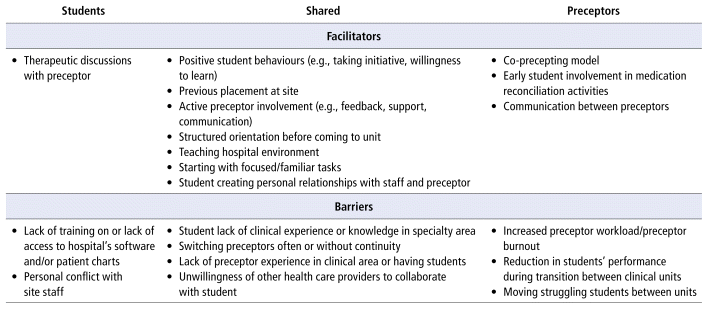
Student and preceptor interview participants identified several facilitators and barriers related to integration of students into the practice site, as shown in Table 1.
TABLE 1 Facilitators and Barriers to Student Integration Reported by Students and Preceptors
Value of Student Integration
The value of integrating students into the site’s clinical activities during the APPE rotation was reported by both preceptors and students during the interviews and was echoed in many course evaluation comments. For preceptors, it was clear that pharmacy students’ ability to “extend” pharmacist services meant different things to different individuals. In particular, the ability of students to extend the role of the pharmacist was dependent on both the learner and the task. Many preceptors felt that students were able to extend pharmacists’ care by completing assigned focused tasks, while a few felt that students increased the number of patients that pharmacists were able to see, and even fewer felt that students played a role in expanding the site’s delivery of patient care services. By having students complete these focused tasks, see extra patients, or complete extra services, preceptors reported that they gained time to complete additional tasks of their own. However, some of the preceptors who did not perceive the student as extending their reach felt that any time saved was redirected back into teaching the students.
Many of the students acknowledged and valued feeling integrated into the practice. Forming strong relationships with their preceptors and other health care workers was reported to increase confidence within their assigned clinical areas, and many students felt they were contributing positively to their rotation environments. Students voiced that the level of independence they were able to acquire was valuable, as it improved their confidence in making recommendations and in applying learned concepts to real cases. Students also reported feeling inspired by observing the pharmacist’s role within the clinical health care setting and witnessing the impact of their contributions on patients.
DISCUSSION
This evaluation study of an inaugural 12-week CHC APPE rotation in a hospital setting showed that students were able to perform cpKPI activities and clinical pharmacy services with varying levels of supervision and independence. Assigning focused or uncomplicated clinical tasks to students early in the rotation was helpful to facilitate student integration and learning. The ability of students and preceptors to build mutual trust and the use of a co-preceptor model were important elements to successful student integration as part of the clinical placement. Many preceptors felt that students were able to extend the role of the pharmacist to a greater or lesser degree, depending on the particular learner. Students valued becoming integrated into the practice setting and felt this positively contributed to their learning. Lack of student knowledge of specialized clinical areas and lack of continuity due to frequent transitions between clinical units or preceptors were reported as challenges to student integration.
Student integration and involvement in meaningful and impactful patient care activities are important parts of the experiential learning process.2,8 The most extensively studied student activities in the inpatient pharmacy setting are medication history taking, medication reconciliation, and patient education.2,5 This evaluation study showed that assigning focused or uncomplicated tasks (e.g., medication reconciliation, patient education) to learners early in the rotation helped to build their confidence, competence, and independence and facilitated their integration into the practice site. From a learning theory perspective, repeated exposure to routine or common activities in the workplace, as well as exposure to new activities, is required for learners to engage in thinking and acting processes from which they construct, reinforce, and organize their knowledge.7 Learner involvement in these types of clinical activities has the potential to support the willingness of rotation sites to host learners, while also allowing learners to develop independence and a sense of responsibility for patient care to support their own practice readiness and contribute to the delivery of cpKPI activities within the practice environment.2,5 Student involvement in more complex tasks (e.g., patient workups, DTP resolution) is likely to require more time to develop knowledge and skills in the particular clinical area, as well as requiring closer supervision and guidance. Case complexity may be high in specialized inpatient practice settings, and students with an entry-to-practice level of competency would not be expected to manage highly complex cases without some preceptor guidance. Integrating students into cpKPI activities that are less complex initially could be an effective way to facilitate student integration and build the skills and confidence to take on tasks with added complexity. Integrating students into cpKPI activities in the practice setting also served to support the general learning outcomes for the course (e.g., care provider, collaborator, communicator) and aligned with the expected level of guidance (i.e., minimal) at the end of the rotation that was required to successfully complete the course and to facilitate practice readiness.
A main aim of this evaluation study was to identify elements of rotation implementation that facilitate student integration to improve program effectiveness and inform future changes. The findings of this study have been used in developing recommendations for supporting student integration into hospital clinical practice settings in the CHC APPE rotation (Box 2).
BOX 2. Recommendations for Supporting the Integration of Students into Hospital Clinical Practice Settings during Advanced Pharmacy Practice Experiences in Collaborative Health Care Settings
- Provide early structured orientation and onboarding for students
- Use a co-preceptor model with a limited number of preceptors to facilitate continuity in terms of expectations, communication, and student feedback
- Host learners in clinical settings that intentionally foster student integration and transfer of skills between clinical settings (e.g., one clinical setting for 12 weeks; 2 similar clinical settings for 6 weeks each; 3 clinical settings for 4 weeks each that are similar or that progress from general patient care to more complex patient care in a logical manner)
- At the start of the rotation, assign focused tasks (e.g., medication reconciliation, risk assessment, patient education, common drug therapy problems), then gradually increase complexity and autonomy based on learner confidence and competence
- Foster opportunities for students to build relationships and trust with preceptors, staff, and other health care providers
- Reinforce and acknowledge the student’s role and contribution to patient care in the practice setting associated with providing clinical services
Although student integration into clinical activities may extend the role of pharmacists in the practice setting to various degrees, the extent to which this may be achievable depends on individual students’ abilities and the types of clinical services provided within the practice setting. Chow and others14 found that the number of patients receiving admission medication reconciliation was significantly greater when this task was performed by pharmacy learners partnered with pharmacists than by pharmacists alone. The same authors also found that the level of independence and reliability depended strongly on the student’s ability,14 which has implications for widespread integration of students into clinical pharmacy services. Further work is needed to identify specific prerequisite knowledge, skills, and attitudes for learners to be ready for integration into clinical services during APPEs. In addition, the provision of specific cpKPI activities by pharmacists varies among hospital practice settings, therefore making it difficult to implement student integration in a consistent way across rotation sites. Further work needs to be done to understand a logical progression of task assignment to support student learning and cpKPI contribution at all practice sites.
CONCLUSION
The evaluation of pharmacy student integration into clinical services during a CHC APPE in the hospital setting identified elements that positively supported students’ learning and contributions to the practice setting. Both preceptors and students valued student integration. Lessons learned during this project may be helpful for other pharmacy experiential education programs.
References
1 Danielson J, Craddick K, Eccles D, Kwasnik A, O’Sullivan TA. A qualitative analysis of common concerns about challenges facing pharmacy experiential education programs. Am J Pharm Educ. 2015;79(1):06.
Crossref PubMed PMC
2 Legal M. Advanced strategies in pharmacy experiential education. Can J Hosp Pharm. 2019;72(3):239–44.
Crossref PubMed PMC
3 Boyce EG, Harris CS, Bingham AL, Chan E, Chapman SA, Chilbert MR, et al. Striving for excellence in experiential education. J Am Coll Clin Pharm. 2020;3(3):678–91.
Crossref
4 Hall K, Musing E, Miller DA, Tisdale JE. Experiential training for pharmacy students: time for a new approach. Can J Hosp Pharm. 2012; 65(4):285–93.
Crossref PubMed PMC
5 Kennie-Kaulbach N, Cameron K, Humphrey M, Donovan C, Isenor JE, Toombs K, et al. Pharmacy student contribution to direct patient care during inpatient hospital experiential rotations: a scoping review. Int J Pharm Pract. 2023;31(6):585–93.
Crossref PubMed
6 Cruess RL, Cruess SR, Boudreau JD, Snell L, Steinert Y. A schematic representation of the professional identity formation and socialization of medical students and residents: a guide for medical educators. Acad Med. 2015;90(6):718–25.
Crossref PubMed
7 Billett S. Learning in the workplace: strategies for effective practice. Allen & Unwin; 2001.
8 Cameron K, Fernandes O, Musing ELS, Raymond C. Increasing capacity for experiential rotations for pharmacy learners: lessons learned from a multisite teaching hospital. Can J Hosp Pharm. 2016;69(1):23–9.
Crossref PubMed PMC
9 Accreditation standards for Canadian educational programs leading to the Doctor of Pharmacy (Pharm.D.) degree June 2023. Canadian Council for Accreditation of Pharmacy Programs; 2023 [cited 2024 Oct 31]. Available from: https://ccapp.ca/canadian-university-degree-programs-in-pharmacy/
10 Stufflebeam D, Coryn C. Evaluation theory, models, and applications. 2nd ed. Jossey Bass; 2014.
11 Frye AW, Hemmer PA. Program evaluation models and related theories: AMEE guide no. 67. Med Teach. 2012;34(5):e288–99.
Crossref PubMed
12 Fernandes O, Gorman SK, Slavik RS, Semchuk WM, Shalansky S, Bussières JF, et al. Development of clinical pharmacy key performance indicators for hospital pharmacists using a modified Delphi approach. Ann Pharmacother. 2015;49(6):656–69.
Crossref PubMed
13 Braun V, Clarke V. Using thematic analysis in psychology. Qual Res Psychol. 2006;3(2):77–101.
Crossref
14 Chow M, Lui P, Cameron K, Romanko A, Hamandi B, Gorman S, et al. Assessment of the impact of pharmacy learners on admission medication reconciliation in Toronto, Canada. J Pharm Pract Res. 2021; 51:27–35.
Crossref
Natalie Kennie-Kaulbach, BSc(Pharm), ACPR, PharmD, RPh, is an Assistant Professor with the Practice Experience Program, College of Pharmacy, Faculty of Health, Dalhousie University, Halifax, Nova Scotia.
Naomi Milner, BSc, is a candidate in the PharmD program, College of Pharmacy, Faculty of Health, Dalhousie University, Halifax, Nova Scotia.
Harriet Davies, BSc(Pharm), MEd, is Assistant Director of Practice Experience, Dalhousie University, Halifax, Nova Scotia.
Martina Greco, BHSc, MPH, is a Program Evaluation Specialist with the College of Pharmacy, Faculty of Health, Dalhousie University, Halifax, Nova Scotia.
Jennifer MacDougall, MEd, BSc(Pharm), is Coordinator of the Practice Experience Program, College of Pharmacy, Faculty of Health, Dalhousie University, Halifax, Nova Scotia.
Kyle John Wilby, BSP, ACPR, PharmD, PhD, is Professor and Director with the College of Pharmacy, Faculty of Health, Dalhousie University, Halifax, Nova Scotia.
Address correspondence to: Dr Natalie Kennie-Kaulbach, College of Pharmacy, Faculty of Health, Dalhousie University, 5968 College Street, PO Box 15000, Halifax NS B3H 4R2, email: nkennie@dal.ca
(Return to Top)
Competing interests: For activities not directly related to the study reported here, Harriet Davies served as President/Chair of the Board of Directors of the Pharmacy Examining Board of Canada (2024/25) and as Chair of the Hearing Committee for the Nova Scotia College of Pharmacists. No other competing interests were declared.
Funding: This project was supported by a Scholarship in Teaching and Learning Grant from the Centre for Teaching and Learning, Dalhousie University.
Submitted: January 2, 2025
Accepted: May 12, 2025
Published: September 10, 2025
APPENDIX 1: Semistructured interview questions.
© 2025 Canadian Society of Healthcare-Systems Pharmacy | Société canadienne de pharmacie dans les réseaux de la santé
Canadian Journal of Hospital Pharmacy, VOLUME 78, NUMBER 3, 2025